Short answer: Choose single-phase motors up to about 2.2–3.7 kW where only 220–240 V household supply exists; choose three-phase above that or wherever three-phase power is available, because three-phase motors are smaller, more efficient and start more smoothly. Higher IE classes (IE2, IE3) cost more upfront but repay quickly on motors that run many hours a year.
Start with the supply you have
The power supply usually decides the motor type. Homes and small farms typically have single-phase 220–240 V; workshops and factories have three-phase 380–440 V. Single-phase motors are practical up to about 3.7 kW; above that, starting current and size make three-phase the sensible choice.
Single-phase motor types
| Series | Design | Best for |
|---|---|---|
| YC / MC | Capacitor-start | High starting torque: compressors, mills |
| YY / MY | Capacitor-run | Fans, pumps, light loads, quiet running |
| YL | Dual-capacitor | Combines strong start with efficient running |
Why three-phase motors are better where available
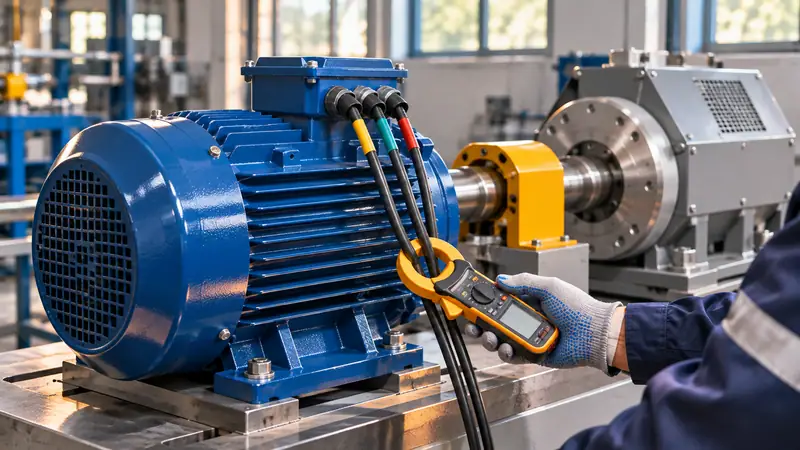
Three-phase induction motors produce a naturally rotating magnetic field, so they need no capacitors, start smoothly, run with less vibration and are smaller and lighter for the same power. Our YS and Y2 series cover general duty; the YX3 series meets IE3 premium efficiency.
IE efficiency classes
IEC 60034-30-1 defines IE1 (standard), IE2 (high), IE3 (premium) and IE4 (super premium). Energy is by far the largest cost over a motor's life — often more than 90% of total cost of ownership for motors running continuously — so a higher class pays back fastest on long duty cycles.
Annual saving (kWh) = kW × hours × (1/η_old − 1/η_new)Example: a 2.2 kW motor running 4,000 h per year, moving from 79.7% (IE1) to 86.7% (IE3) efficiency, saves roughly 890 kWh per year.
Frame and mounting
Check frame size (for example 80, 90S, 90L, 100L), shaft diameter and mounting: B3 foot-mounted, B5 large flange, B14 small face flange, or combinations. Matching these to your machine avoids costly adapters.
Protection and insulation
IP54 suits most indoor and sheltered outdoor duty; IP55 adds better protection against water jets. Class F insulation with class B temperature rise gives a healthy thermal margin, extending winding life in hot climates.
Frequently asked questions
What is the difference between capacitor-start and dual-capacitor motors?
A capacitor-start motor uses a start capacitor that is switched out once the motor reaches speed, giving high starting torque. A dual-capacitor (capacitor-start, capacitor-run) motor keeps a run capacitor in circuit, improving efficiency, power factor and quietness during operation.
What does IE3 mean?
IE3 is the "premium efficiency" class defined in IEC 60034-30-1. An IE3 motor wastes noticeably less energy than an IE1 motor of the same rating; for a 2.2 kW motor running 4,000 hours a year the saving often exceeds the price difference within two years.
Can I run a three-phase motor on single-phase power?
Only with a phase converter or a VFD that accepts single-phase input. For small motors it is often simpler to buy a single-phase motor or a single-phase-input VFD.